Our family story goes back to Poland…

To the town of Brzezin… בז’ז’ין

Brzeziny Timeline – Early days
- 1139 the seat of a Roman Catholic parish
- Foundation charter and the rights conferred by the city confirmed in 1364 by King Casimir the Great
- 1462-1826 in possession of the Lasoccy family
- Jews first recorded in Brzeziny in 1550 (but may have arrived earlier)
- Where did they come from ?
- 1565 Population 2000 – c60 Jews 3%
- 1626 Pogrom and blood libel – 5 jews killed
- 1656-1658 Russo-Swedish War – Swedes with Chmielnicki destroy town.
- 1656 Hetman Stefan Czarniecki’s troops murder 40 families
- 1765 Polish army pogrom 243 Jews killed
- 1790 Icek Mandel born in Brzeziny
- 1793 Population 833 – 162 Jews 19%
19th Century
- 1792 until 1806 – period of substantial German immigration
- 1797-1807 Annexed to Prussia
- From 17 April 1797, it was required that every Jew add to his Jewish name a surname, which he could choose himself.
- Early 1800s Brzeziny bigger than Lodz
- 1804 – 275 Jews
- 1807 – 1815 Brzeziny under the Duchy of Warsaw
- Reb Szmuel Pachter guides Napoleon
- 1815 Annexed to Russia by Congress of Vienna
- 1815 Izabella Lasocka encourages German Jewish immigration
- 1820 Population 2444 – 557 Jews 23%
- 1827 Population 3492 – 943 Jews 27%
- 1850 Population 4783 – 1887 Jews 39%
- 1860 Population 5185 – 2437 Jews 47%
- 1880 -1939 Jewish immigration from Russia
- 1890 Population 7980 – 3767 Jews 47%
- 1893 Population 8794 – 4397 Jews 50%
- 1880 onwards – Jewish emigration to USA, Brazil, France UK, & Palestine
20th Century
- 1913 Population 17108 – 9307 Jews 54%
- 1914 WW1 battle between German and Russian forces – widespread destruction and depopulation
- Brzeziny occupied by Germany until 1918
- 1918-1939 Polish Republic
Avadim Hayinu עבדים היינו
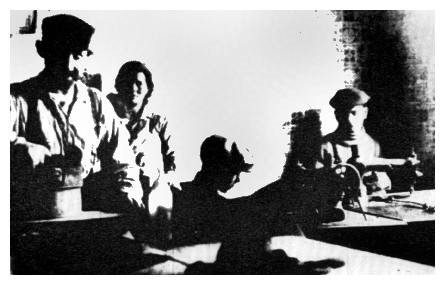
“At that time this was not just an ordinary little town in Poland. No, it was Brzezin, the town of work, the town of factories, of tailor-workshops, of the Jewish proletariat. From here they did indeed send the fanciest clothing out into the great world, into the warehouses; surely we clothed an entire world!”
- 1898 288,000 garments produced
- 1911 600,000 garments + 200,000 overcoats
- 3000 tailors
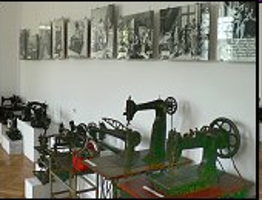
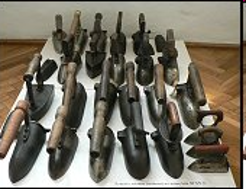
“I see again, as before, the hundred sewing machines and the great Brzezin tailor workshops. I see the Jews who work with all their strength; I see them heating the irons; I see, as I once saw, the way they pack the Brzeziner bundles of clothing, stuff the transport crates with the blue inscriptions on the large boards. There the wagon drivers crack their long whips at the harnessed horses, and the wagons, with the wooden poles on the sides, loaded with high crates of goods, go off with the crates and with the wagon drivers. They go off to the train, to the railway station; they go into the wide world.”
Industrialisation
Many causes contributed to the rapid and tumultous growth of the tailoring industry in Brzezin.
- The proximity to Koluszki, which was one of the most important railroad junctions; the nearness to Tomaszow and, principally, to Lodz, which, in a short time, had become one of the greatest textile centers in Europe;
- and the fact that in Brzezin tailoring, in general, was a widespread trade.
- Also, the majority of Brzeziner tailors produced finished clothing, contrary to the custom that tailors who sewed garments made to measure.
- Third was the lack of a Torah tradition that in other towns gave rise to a sharp resistance to the new way of life accompanying industrialization.
All these factors transformed Brzezin, in a very short time, to become one of the largest centers of the ready-made clothing industry in the Russian Empire of that time.
“Brzeziner Jews displayed amazing ability to be enterprising. It is worthwhile to take the opportunity to point out the fact that those who were most energetic, daring, and with the most creative ideas, came from the deepest Brzezin poverty.”
Social and religious makeup
“There once was a town of Jewish tailors – Brzezin. From early dawn until late at night one could hear the music of the Singer sewing machines. It was the music of hard work, of intense anxiety, of a hard life, but also of noisy youth, semi-intellectuals, observant Jews, Hasidim who lived and had aspirations in the small Jewish town Brzezin.”
“The creativity, the activity, the work, the bustle, the coziness, the informality, the quarreling between givers and takers of work, the travelers, wagon drivers, tailors, shoemakers, elegant Jews, Hasidim, friends, intellectuals, semi-intellectuals, the shuln [synagogues], bote-medroshim [prayer/study houses], Hasidic shtiblekh [houses of prayer], mikvoes [ritual baths], organizations, Jewish banks, charitable institutions”
“Jews of all kinds, frum un fray (observant and non-observant), teachers and tailors, Hasidim and socialists––all those who built an honest, life of hard work, built a unique industry.”
“It would be no exaggeration if I were to say that our town was a miniature of the entire Jewish population in Poland. So, for example, one found there
- Hasidim,
- the middle class,
- the enlightened,
- the simple people,
- and the intellectuals of all kinds.”
“Even the goyim spoke Yiddish”
Map of Jewish Brzezin

According to the map of our town that was in use, Jews occupied residential streets according to their occupation and financial status.
The magaziners [owners of clothing enterprises] lived on these streets––Koluszki, Rogow [Sienkiewicza], and a part of the marketplace up to the corner of Rogow Street. Merchants took up the entire main marketplace up to Synagogue Lane [Joselewicza]; smaller shops were on Apothecary Street [Sw. Anna/St. Ann].
The tailors, the majority of the town, were concentrated on the poorer streets, where rent for an apartment was not exorbitant––for example, Pig Street, Zielinski’s [Moniuszki?], Cloister Street [Reformacka], Court Street [Staszica], Small Street [Krotka?], Lodz [Kosciuszki] Street, and New Town [Nowe Miasto].


Politics and Labour organisations
- Jews in the town council
- Leftist Poale Zion
- Rightist Poale Zion
- Bund
- Hitachdut
- Agudah
- Mizrachi,
- Various Zionists
- Gordonia (Chalutzim)
- WIZO
- Revolutionists, and Communists
- The Master Tailors’ Union
- The Clothing Workers’ Union
- The Commercial Employees Union
- The Transportation Union
Culture

Jankiel Kurdelas, the klezmer
Gerszon Sirota – a fine musician, violin player, and music expert 
Yiddish Poets
–Jakob-Ber Gips
–Melech Vogel
The writer Z. Segalowicz
After WW1 Sports clubs
Education
- Talmud Torah
- Early chedarim, in most cases, conducted in the homes of poor teachers in the kitchen or bedroom, often the teacher’s only room. “Unsanitary, and in many cases, shocking khedorim”.
- Later, united cheder – Yesodei HaTorah
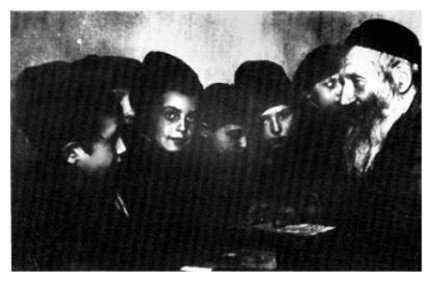
“Besides Reb Jankele, e”h, there were other teachers – Reb Abraham Mojsze, Reb Eliezer, Reb Szlama Peretz. Then there were the Chumash-Rashi teachers – Reb Pinchus (we called him Pinyele) and the Glovner teacher (from Glowno). Both of them lived in Dwojra-Laja’s building behind the besmedresh. I began studying Chumash-Rashi with Pinyele. The rebbe used to beat us children without mercy. We used to quake if he just looked at us. Then there were Reb Nehemiah, whom we called the Zvorny [Russian], Reb Szmuel Mojsze, the Radzyner teacher, Reb Judel Soyfer’s [the scribe’s] son-in-law, who was already a Gemore teacher, and the Skierniewice teacher. I studied with all of these. The last one lived at the home of Reb Lajbel Shenker in the garret room. I also remember Reb Melamed Josip and Reb Chaim-Mojsze.”
- Three state public schools in Brzezin, one was set aside especially for Jewish children.
- Private schools e.g. Yavne
- Gymnasium [high school] in town, on Koluszki Street, in which many Jewish children studied after they completed the public school.
The shul, pride of Brzezin

“A long time ago, Brzeziner Jews contributed, despite their considerable poverty, to build a temple synagogue building with a magnificent appearance. The synagogue was an exception among hundreds of synagogues in Poland. A rich woman by the name of Perla, the widow of Mojsze-Zajdl Goldberg, contributed several thousand rubles at that time for the Holy Ark. Indeed, it was artistically carved with all the musicians from the Temple in Jerusalem and with an eagle [Polish national symbol]. And how artistically the eastern wall of the synagogue [where the most highly privileged sat] was carved! The fiddlers and all the other music makers made an unforgettable impression.”
“The new shul [synagogue] (built 1885) was one of the most gorgeous and expensive synagogues in Poland. The impressive building – the highest in town – stood near the meadows, opposite the old besmedresh [prayer house], whose walls had absorbed the prayers and tears of generations of Jews. The prayer house and the new majestic, richly decorated synagogue symbolized the old and the new Brzezin more than anything else.”
Shul, Stiblach and other Minyanim
- Main synagogue and Bet HaMidrash
- Chassidishe stiblach meeting in rooms in peoples’ houses:
Gerer stiblach | Skierniewice stibl | Often business was done during minyanim. Meetings were held in the shul or Bet Hamisdrash |
- In addition, there were various khevres [societies] – Khevre Tilim [Society for the Reading of the Book of Psalms], Khevre Eyn-Yankev [“Jacob’s Spring” Society], Khevre Kadishe [Burial Society], Khevre Lines Hatsedek [Society to Care for the Sick], and Khevre Kheytim [Tailors’ Society].
- There were Chazzanim, Mashgichim, Shochetim, Shammashim, Mohelim, Bath Attendants, the gravedigger. Melamdim, Gabbaim – every sort of communal official and servant.
Great Rabbis
- “In the year 1768, approximately, when Gonta, the successor to Chmielnicki, had destroyed entire Jewish communities in the Ukraine, Jozef Jehuda Szpiro, with his four children, was rescued and one of the four sons, Reb Fiszele Szpiro, was brought up in our shtetl Brzezin. Reb Fiszele devoted himself to Torah. He was one of the founders of the Hasidic movement. The rebbe Reb Fiszele Szpiro was crowned the Rebbe ben Yokhai [founder of Cabala] of his generation.”
- “In his time Reb Syna Sapir was one of the greatest and most renowned of the group of rabbis in Russia and Poland. The other two were Reb Yitzhok Elchonon Spektor, the Kovner [Kowno] rov, and Reb Eliahu Chaim Meisel, the Lodzer rov. Reb Syna must certainly have been a great personality, since the Brzeziner Jews had taken him, a misnaged, many years earlier as their rabbi. The entire kehile [Jewish community] in Brzezin was, at that time, in the hands of the Hasidim, Vorker [Warka] and Kotzker Hasidim. When one leafs a bit through Reb Syna’s books, one immediately sees his greatness.”
- “Also several distinguished maskilim [adherents of Enlightenment/Haskalah] came from the besmedresh, such as Reb Chaim Icek Grynfeld, Reb Nachman Gutkind, Reb Szymele Krongrad, as well as Reb Herszel Lajchman, who helped spread the concept of Mizrachi.”
- Brzeziner rov, Reb Israel Dwarter
- “Rabbi Abraham Joszua Borensztajn in Brzezin was well-known among the brilliant men in Poland and the author of Sanhedrin Ktane [minor religious court].He was moyre tsedek [a guide to justice] in Brzezin. His son, Reb Zalman Jekutiel, occupied the chair of the rabbinate in Brzezin after Rabbi Reb Israel Dwarter.”
Churban
Destruction of the stetl – September 1939 to May 1942
Bombing
Invasion
Humiliation and abuse
Burning and demolition of the shul
Ghetto creation
Torture and Execution
Ghetto liquidation
Deportation
Extermination
- 1939 Population 13,000 6850 Jews 53%
- Some say 10000 or more Jews
- September 1939 – Town bombed by Germans
- Nov 1939 Occupied by Nazis– renamed Löwenstadt
- 1939 Judenrat formed and then in May 1940 ghetto created.
- 11th November 1939 Germans burn & later blow-up synagogue.
- May, 1942 Final liquidation of the ghetto.
- Half the Jewish community killed at Chelmno
- Rest sent to Lodz ghetto and then to Auschwitz, Bergen Belsen, Majdanek and Treblinka.
- At end of war the city is bombed again (by the Russians) and burnt
- Jewish population 1942 to 2020: 0
The cemetery walls and ohel that were destroyed.

Cemetery gate
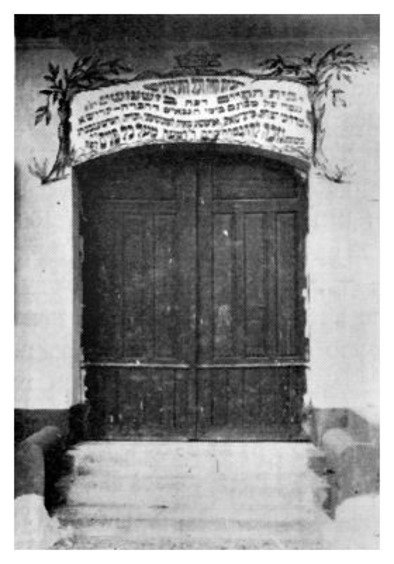

“Here, in the Brzeziner cemetery, the murderers had not allowed even the dead to rest in their eternal sleep. Certainly the bare field, where the cemetery had been, is even more tragic because of the fallen gravestones, which could have told the history of a people who had lived on that very soil. The Nazis and Poles tore out the gravestones and paved the sidewalks with them; the earth was plowed, everything that was sacred to us is dishonored and made unclean.”

“Once the cemetery of Brzezin stood here . . . the mound that is visible in the picture below is a mass grave for the collected bones that were found after the great destruction”

The one surviving grave, the Ohel of Reb Shimon Baal Rachmanos

Remembrance and reconstruction
Presidium of the first assembly of landslayt in Israel
Seated from right to left are David Rozenberg, Israel Fiszer,
Szmul Sulkowicz, Lemel Horn, Mojsze-Icek Frankensztajn,
Chaim-Icek Grynfeld, Jechiel Erlich, Josef Szajnberg,
Jechiel-Michal Herszenberg, David Zicher, and Har-Jaffe (Szajnberg)


Gathering of the Israel landslayt at the laying of the
cornerstone for Shikkun Brzezin [Brzezin apartment project]
At the main table are seated the landslayt Abraham Fuks
(from America), Lemel Horn, and Har-Jaffe (Szajnberg)

Planting a tree in front of the Bet-Am [house
of the people] in Israel, in the name of Louie
Horn, secretary of the Brzeziner Relief
Committee for many years
From right to left: Morris Frank, Benkel,
Lemel Horn, e”h, and Har-Jaffe (Szajnberg)
The Shikkun Brezin was located in Kiriat Ono (then Kfar Ono). Does anyone know where it was or what happened to it?

Below: A memorial gathering of landslayt [fellow townsmen] in Israel,
held in the meeting hall, of Shikun Brzezin [Brzezin housing project] (Yizkor meeting) in Bet Ha’am


Memorial evening in Paris with representatives from both societies [Israeli and Parisian]
From left to right: Mrs. Flam, Kujawski, Flam (blocked), Freed, Frajm (Chairman of the
Society), Morris Horn (Honorary President), Chazan Pinkas
(President of the Brzeziner Society), Zajdenberg, Horn, Koziv, Bernard Freed, Homel

Brzeziner landslayt in Paris at a memorial gathering in 1961
From right to left: Zajdenberg, Simon, Chazan Pinkas, Horn, Frajm, Freed, Flam, Kujawski

A group of Brzeziner Jews in Australia with guests from America, Dr. Esther and Jehuda Fuks
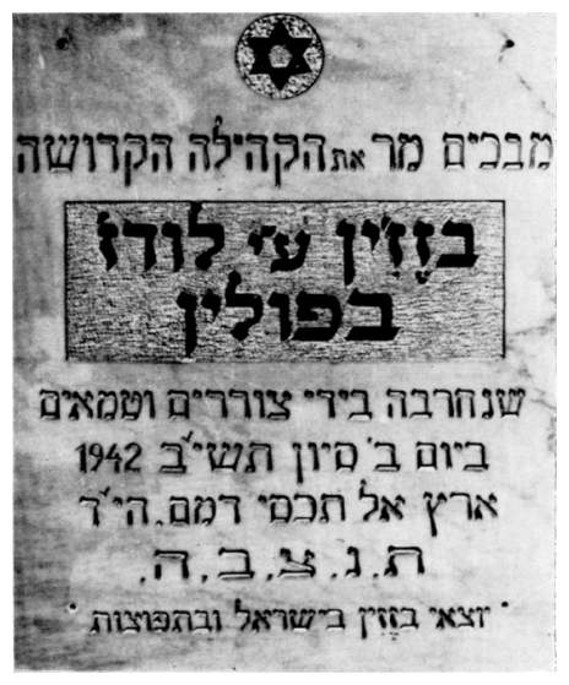
Memorial tablet on Har Tziyon at the Martef HaShoah (Forerunner to Yad Vashem)
Brzeziner landslayt at the Ner Tamid [Eternal Light] of the Memorial of the Unknown Jewish Martyr [Memorial du Martyr Juif Inconnu]

Monument erected at the cemetery of the New York landslayt as a memorial to the martyrs Beth David Cemetery, Long Island NY

“Today Brzeziner Jews are scattered and spread all over the world.” 1961
| COUNTRY | FAMILIES | INDIVIDUALS |
| USA | 450 | 2000 |
| Canada | 40 | 160 |
| Brazil/Argentina | 30 | 120 |
| Australia | 15 | 50 |
| France | 50 | 160 |
| Belgium | 15 | 48 |
| Sweden | 10 | 30 |
| Germany | 20 | 45 |
| Poland | 15 | 48 |
| Africa | 10 | 25 |
| Israel | 350 | 850 |
| Russia (estimated) | 50 | ? |
| TOTAL | 1005 | 3536 |
But it puzzles me why they did not include us London Brzeziners? The French relatives and Milton in New York knew we existed.

